Usha’s Pickle Digest
by Usha Prabakaran

Published in 1998 by the author’s own Pebble Green Publications in Chennai, India.
It was late April and I was browsing the cookery shelves of a bookstore in Mumbai. Like all avid collectors of one thing or the other, I have learnt to quickly pick grain from chaff. My expertise is, of course, aided by the fact that the food-and-drink sections of all mainstream bookstores in India look alike: piles of publications from serial cookbook writers and compilers, a few guides to eating in city XYZ, coffee-table tomes from foreign publishers, and “chef’s series” pocket books. I rapidly scan the spines of these books, eyes peeled for the unusual or the local. That day, however, I flipped through “Cooking in Six Minutes” by one of the aforementioned copious authors. A few books down the shelf, I came across “Cooking in Three Minutes” by the same author. I wondered how far this series would go, and sure enough, out tumbled “Cooking in 60 Seconds”. Just like all problems of this world can be solved if you smile and think positively, so will you be relieved of your kitchen burdens if you think of cooking as the time that a pot spends in contact with the stove. Maybe it was the blistering summer heat or maybe I had looked at one cookbook too many, but I suddenly felt weary of the pervasive silliness of the food publishing world. For an antidote, I turned to two things: slow, sun-cooked pickles that would take days or weeks before they were ready, and a cookbook narrow in its focus, yet unmatched in range and depth.
Usha’s Pickle Digest is the definitive book for Indian pickles; the first and probably the last word on vegetarian pickles, unless the author publishes a second volume. There is not much I can say about the Digest or about Usha that has not already been said elsewhere. One vaguely knew that India has a vast repertoire of traditional pickles, but one did not know that a thousand pickles across 131 ingredients are within the realm of possibility. One had heard of mango pickles, lemon pickles, chilli pickles, tomato pickles, even okra pickles; but pickles made out of coconut, kokum, hibiscus flowers, artichokes, sugarcane, pomegranate, or spinach were beyond our imagination. All the recipes rely only on natural preservatives such as salt, oil, vinegar, and spices. The life of each pickle is indicated at the end of the recipe. There is also something very satisfying about the meticulousness with which the recipes have been titled and indexed for easy access. Even if pickles do not tickle your culinary fancies, the book offers plenty – an extensive glossary of ingredients in ten languages along with botanical names, methods to detect adulteration, buying and storage guides, and several other practical kitchen tips.
The best part of this book for me personally, however, is the profound sincerity of purpose underlying this work. The Digest was published neither for fame nor money. Usha’s patent enthusiasm and desire to share the results of her pickling research is the driving force of this book. We tend to romanticize secrecy in the culinary arts. Prized recipes and techniques are either kept shrouded in mystique or published omitting an ingredient here or instruction there. Clearly, the recipes and kitchen wisdom in this book have been developed through years of diligent and sustained effort. That she went the several extra miles to present her knowledge in a clear and forthcoming manner indeed commands our respect. It is also why we keep rummaging tons of chaff in search of a few precious grains.
Ingredients:
500 grams cut raw mango, small pieces
75 grams salt (use kosher or crystal salt)
35 grams chilli powder
10 grams fenugreek seeds
10 grams cumin seeds
5 grams asafoetida
200 ml sesame oil
5 grams mustard seeds
A few sprigs curry leaves
Method:
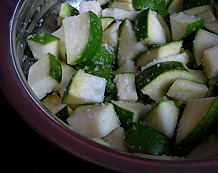
Sprinkle salt on the mango pieces and marinate for a day. Next day, remove the mango pieces from the resulting juices (“salt waterâ€Â). Reserve these juices in a refrigerator.
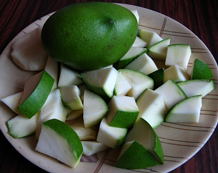
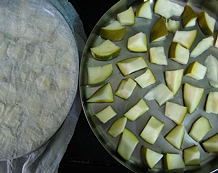
Place the mango pieces on a steel tray or thali and sun-dry for four days (till the mango pieces are three-fourths dry).
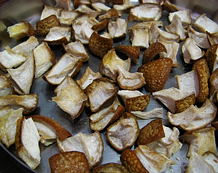
At the end of the fourth day, roast in a little oil the fenugreek seeds, cumin seeds, and asafoetida and grind to a powder. Combine with the chilli powder and add this spice-blend to the dried mango pieces.
Heat the sesame oil, add the mustard seeds and curry leaves, and allow to crackle. Pour in the salt water and an equal volume of plain water. When the mixture begins to boil, stir in the mango mixture. Let it come to a boil again, and then remove from heat.
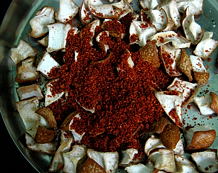
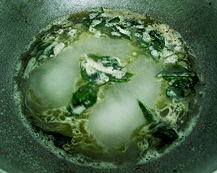
The pickle is ready to use after five days. It lasts for six months.
Notes:
I have presented the ingredients as originally provided in the book. When I prepared this pickle, however, I had neither measuring cups/spoons nor a weighing scale handy. I kept tasting throughout the process. You can adjust the spices according to your taste and the tartness of the mangoes, but please do so in a way that maintains the balance of flavours. The primary tastes in this pickle should be sour, chilli-hot, and salty.
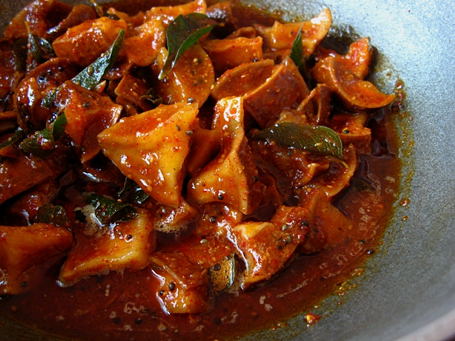
Text and Photographs: Veena Parrikar
Previously in the Cookery, Indic Series:
Introduction
Salads for All Occasions – Vijaya Hiremath
Cooking with Green Leafy Vegetables – Shyamala Kallianpur
Regional Rustic Recipes by Manipal Mahila Samaj


Always wanted to know the recipe for dried mango pickle. Thanks a lot, Veena, for sharing with detailed, step-by-step pics.
Comment by Jayasree — June 2, 2008 @ 1:04 am
This is a book I’d buy. Bored with same old mango, lime, lemon, mixed veg, garlic pickles, I am ready to try other pickles. Looks like a great buy.
Thanks Veena.
Comment by Kay — June 2, 2008 @ 4:34 am
I really enjoy your book reviews veena. When I read “slow sun cooked pickles” I was reminded of my mother’s Chunda recipe- a gujarati pickle cooked in the sun. I remember tasting the sun in it- you dont get that flavor in packaged pickles. Thank you for highlighting Usha’s gem.
Comment by ms — June 2, 2008 @ 7:19 am
Wow, this book looks like a good one on pickles. Lovely review. And the mango pickle is just delicious.
Comment by Uma — June 2, 2008 @ 11:58 am
Lovely review Veena..pictures are mouth watering!..
Comment by Srivalli — June 3, 2008 @ 2:54 am
Indira,
I am glad that the website issues have been
resolved and I am able to post a comment.
Veena,
Very nice post. Reminds me of my childhood summer vacations when making pickles was a big project for the whole family. My Dad actually used to take a day off to help my Mom 🙂 Gone are those wonderful days when the whole family was involved in making these mouth watering wonders.
Comment by Anjali Damerla — June 3, 2008 @ 9:44 am
Veena,
This book sounds great! Homemade pickles are always very tasty.
Comment by Kumudha — June 3, 2008 @ 10:18 am
Looks like a great book…is this avilable online anywhere? I would defenitely like to buy itasap 🙂
Comment by Lakshmi — June 3, 2008 @ 3:40 pm
found this reference to the book at “The Published articles of Rushina Munshaw Ghildiyal”:
To obtain a copy of this book please get in touch with the author at usha.r.prabakaran@gmail.com
Comment by trevor — June 4, 2008 @ 12:43 am
I was wondering if someone can tell if it was possible to find Neem (Vepa) leaves in USA? Like in any store or something?
Comment by Raj Chandra — June 5, 2008 @ 10:35 am
This is the same way my Mom makes pickle. The process of drying the mango pieces is the same for all types of pickle and then Mom adds different spices to make different variety of pickles in this time of summer specially . You bring back those nice memories to me Indira. thank you for sharing this 🙂 .
Comment by Pooja — June 5, 2008 @ 12:32 pm
Veena,
You’ve written a review worthy of the book.With pictures and notes on how you made it, the love and enthusiasm you have for pickling comes through.
Comment by uma — June 6, 2008 @ 2:05 am
Well done Veena.Beautiful post,wonderful pictures.
Comment by shankarkotkar — June 6, 2008 @ 7:13 am
I enjoyed this site very much and have taken away a better insight. I will recommend this site to everyone I know. More people should step into.
Comment by vs — June 10, 2008 @ 11:28 pm
Hi Indira,
Am a regular reader of your blog and a big fan of yours. inspired by this picture of tangy pickle I recently made a bottle with 500gms of mangoes. but when I put them in the jar the upper layer is not covered by oil.I mean with 200gms of oil the upper layer remains dry. the general notion is if the pickle is not entirely soaked in oil then it might attract fungus. so please let me know if it will create any problem in long run or should I heat some more oil and pour in.thanks
Comment by tina — November 3, 2008 @ 5:25 am
Thank you so much for sharing .
where can I buy the book Usha’s pickle digest By Usha Prabhakaran?
I have sent 3 e-mails so far to usha.r.prabakaran@gmail.com
but have never received an answer. Hope Usha is alive and doing well.
Thanks,
J
Comment by Jolie — December 17, 2009 @ 3:15 am
Dear Veena, the meticulous manner in which you have given detailed step-by-step instructions on how to prepare the Sambaara Mango Pickle (my Andhra mom–in-laws heirloom recipe), accompanied with sharp, eye catching & mouth watering pics, is indeed commendable. In fact, I now realize why people in India and the world over, crave for these tasty, hot & spicy/ sweet & spicy/ sour & spicy versions of our pickles. I am inclined to agree with Kay that this is not one of those “same old mango picklesâ€. As Uma & Srivalli have commented yours is a lovely review of the book – “Usha’s Pickle Digestâ€. I know that I’m crazy when it comes to pickling & other areas of cooking that I fancy (baking is not one of those), but you surely take the cake with your perceptivity and uncanny knack to spot a good book when you see one. Thanks Veena. I know this post ought to have come millenniums ago – but I know you’ll forgive me. In fact, you have made me prouder of my efforts than many others and my commitment to my work has grown more. Will stay in touch.
Usha R Prabakaran (I sign off with my full name because Usha is a pretty common name and I don’t want my identity to be confused with somebody else’s).
Comment by Usha R Prabakaran — May 2, 2012 @ 5:53 am
Dear Jayashree,
I know this post is long overdue. But I guess my curiosity got the better of me, did you try the recipe for the dried mango pickle which Veena had taken so much trouble to detail out in words and pictures. How did it turn out? Would love to know.
Usha R Prabakaran
Comment by Usha R Prabakaran — May 2, 2012 @ 6:08 am
Dear Kay,
A belated reply I know, I’m sorry. Glad to know that you are not a run-of-mill kind. This is definitely no ordinary mango pickle. You must try your hand at it. And when you do, I’d love to know the outcome.
Usha R Prabakaran
Comment by Usha R Prabakaran — May 2, 2012 @ 6:11 am
Dear ms, Chunda- that awesome sweet & sour Gujarathi mango pickle with spicy overtones is indeed magic to your taste buds. ms-oh! I can’t quite disagree with you-tasting the sun in it (are you a pickle poet by any chance?) I too am glowing and basking in your words of praise – “thank you for highlighting Usha’s gem†(all my replies are light years late – am I excused? Have not been keeping in good health for quite some time – brain surgeries et al -trying to bounce back.
Usha R Prabakaran
Comment by Usha R Prabakaran — May 2, 2012 @ 6:24 am
Dear Uma, lateness seems to my best friend. I know you’ll let me off. Besides, as I already posted to Veena the review is outstanding – all the more because Usha’s Pickle Digest (smug) happens to be my book. I really fell in love with the Sambaara mango pickle which was passed on to me by my mom-in-law. But the beauty you know Uma is Veena’s creativity – I think she told me she turned out a fabulous Sambaara lime pickle using the same method. Cheers!
Usha R Prabakaran
Comment by Usha R Prabakaran — May 2, 2012 @ 6:32 am
real gem ! Thanks to Indra and Veena, for this amazing blog! real GEM.Never ever have gone wrong trying your recipes
and thanks a ton for these book reviews. Been trying to get a copy of Usha’s pickle digest and Rasam digest, for a year now.
Saradha
Comment by saradha — May 30, 2012 @ 7:09 pm
I need to buy a copy of your book please let me know how to buy it.
Comment by anoop kapur — August 21, 2012 @ 2:50 am